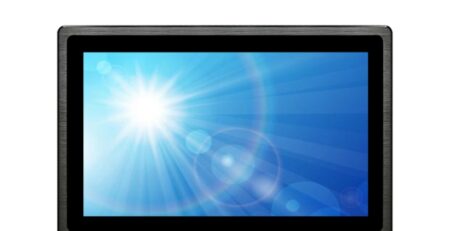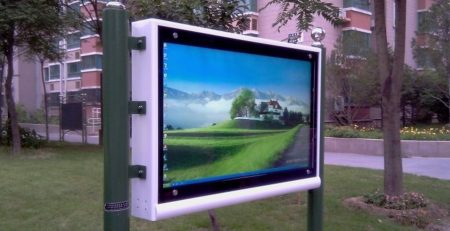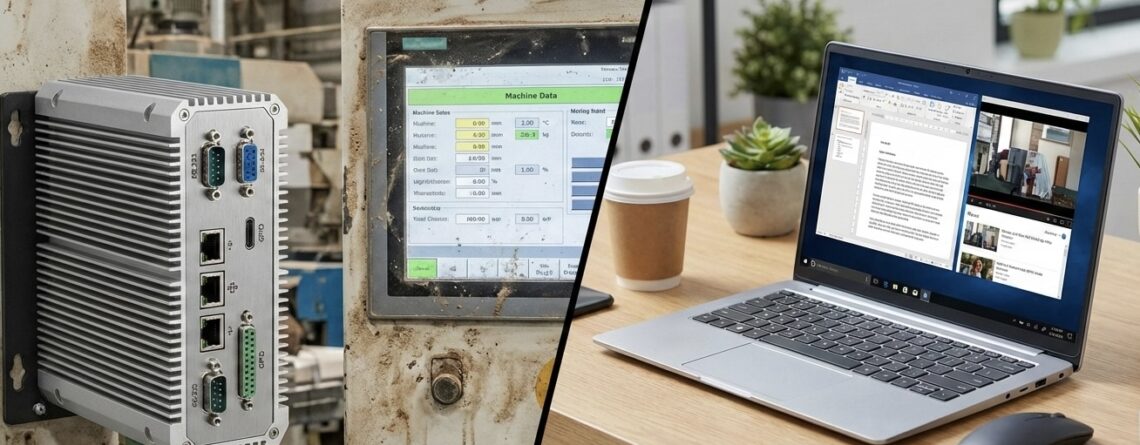
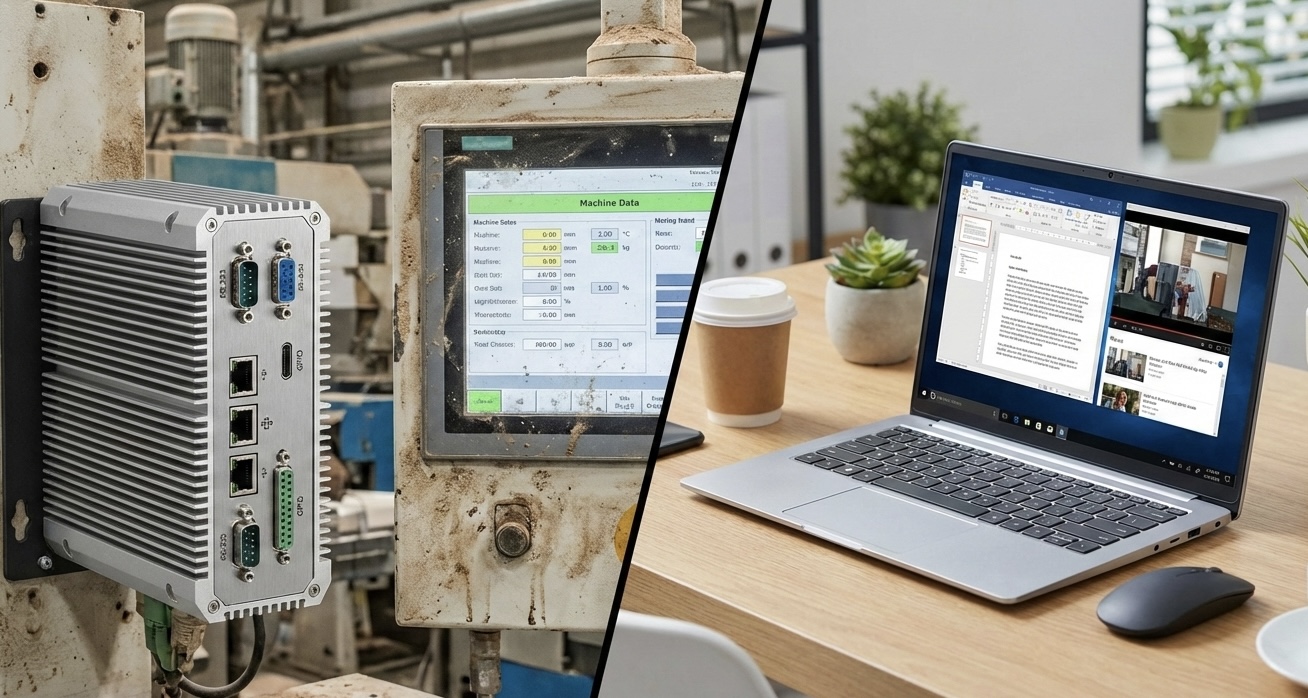
From our clean office desks to dusty factories, bumpy transport trucks, and even deep-sea or space research stations, the environments where computers must operate are worlds apart. This vast difference in conditions has given rise to two distinct branches of design philosophy: consumer-grade computers and industrial computers (IPCs).
Consumer products aim for peak performance and cost-effective aesthetics in comfortable settings. Industrial computers, however, are the “digital bedrock” built for 24/7 stable operation in extreme and harsh conditions. With the rise of Industry 4.0 and the IoT, understanding their deep differences is no longer just a technical choice—it’s critical for a business’s operational reliability and cost management.
I. The Foundation Difference: Circuit Design and Manufacturing
The differences start at the most basic level: the circuit board.
A consumer-grade motherboard is like an economy car. It meets basic needs within a controlled cost, following lenient manufacturing standards that allow minor flaws if they don’t affect core function. An industrial-grade motherboard, however, is built to top-tier “high-reliability” specifications. It demands near-perfect precision in soldering to eliminate any tiny weak point that could cause failure under long-term vibration or temperature swings.
Physically, industrial motherboards are often thicker, multi-layered boards (6-12 layers) using thicker copper layers. This isn’t just about using more material. Thicker copper handles higher electrical currents, helps spread heat, and makes the board stronger against bending from constant vibration near heavy machinery. All this builds reliability from the ground up.
II. Core Distinction: Military-Grade Component Selection
The secret to an industrial computer’s long life lies in its extremely careful choice of every single component.
1. The Capacitor Choice
Common liquid electrolytic capacitors in consumer boards can dry out and fail in heat, often causing crashes. Industrial solutions use solid polymer or tantalum capacitors instead. Their lifespan can be 6-10 times longer, preventing system failures from capacitor issues.
2. The “Derating” Philosophy
Industrial design follows a “big engine in a small car” rule. For example, a capacitor rated for 25V might only be used in a 12V circuit. By leaving a large safety margin, stress and heat on components drop dramatically. This exponentially increases their reliability and lifespan.
3. Across-the-Board Superior Specs
-
Temperature Range: Expands from the consumer range of 0-50°C to an industrial -40°C to +85°C.
-
Memory: Uses soldered ECC memory. It resists vibration and corrects errors, unlike consumer plug-in, non-ECC memory.
-
Storage: Chooses ultra-durable SLC/pSLC industrial SSDs over consumer QLC/TLC drives.
-
Board Material: Uses high-grade materials that won’t warp under high heat.
III. Built to Survive: Fanless Design and Full Protection
In tough environments like factories or outdoors, cooling fans are a critical weakness.
A fanless, sealed design is standard for industrial computers. Heat pipes or vapor chambers move heat from core components to the metal case, which then radiates it away. This removes the risk of fans sucking in dust and failing. It also allows a completely sealed device.
Protection levels use clear IP (Ingress Protection) Codes:
-
IP65: Fully dust-tight. It can resist low-pressure water jets. This suits most industrial settings.
-
IP67/IP68: Can withstand temporary immersion. It’s for outdoor use or areas with flood risk.
-
IP69K: Top-level protection. It resists high-temperature, high-pressure steam cleaning. This is for demanding fields like food processing or pharmaceuticals.
For damp, salty environments, a thin protective coating is applied to the motherboard. This coating acts like an invisible shield against moisture and corrosion.
IV. A Friend of Time: Long Lifecycles and Supply Chain Promises
Industrial investments plan for returns over ten years or more. This clashes with the “fast fashion” update cycle of consumer electronics.
A consumer CPU might be discontinued in 1-2 years. This forces expensive system migrations and software re-adaptation. Industrial computers rely on dedicated supply chains (like Intel IOTG). Key processor models get guaranteed availability and support for up to 15 years.
Furthermore, industrial makers use a fixed Bill of Materials (BOM). Any component change requires advance customer notice. This ensures you can buy an exact replacement part ten years later. Systems also support long-term industrial operating systems like Windows IoT Enterprise LTSC. These systems get security updates for over 10 years and perfectly run legacy industrial software.
V. Quantifying Reliability: From MTBF to Self-Healing
In industry, reliability is a calculated number.
Mean Time Between Failures (MTBF) is a key metric. A robust industrial computer can have an MTBF of 50,000 to over 150,000 hours (about 5.7 to 17+ years). This comes from adding up the very low failure rates of each component.
More distinctive are their built-in self-recovery and remote management features:
-
Watchdog Timer: Automatically forces a system restart if software freezes, recovering operations.
-
Out-of-Band Management (like IPMI): Lets administrators remotely access and repair hardware over a network, even if the main system has crashed. This drastically cuts on-site maintenance costs.
VI. Human-Machine Interaction: Touchscreens for “Hardcore” Environments
Industrial touchscreens are not simple copies of consumer technology.
-
Resistive Touchscreens: A longtime industrial favorite. They work with any tool—gloved hands, oily fingers, or even a pen tip. Their reliability in nasty conditions is unmatched.
-
Industrial Capacitive Screens: Use strengthened glass. Special software allows glove touch and wet touch operation, balancing looks with durability.
-
Haptic Feedback: Mimics the feel and sound of a physical button press. This lets workers operate without looking at the screen (“blind operation”), improving safety and efficiency.
VII. Vertical Industries: Tailored for Compliance
A one-size-fits-all platform can’t meet every industry’s strict rules:
-
Medical Grade: Must follow the IEC 60601-1 standard. It strictly controls electrical leakage (at the microamp level) and has strong electromagnetic compatibility to avoid interfering with sensitive medical equipment.
-
Vehicle/Transport Grade: Handles wide voltage input (e.g., 9-36V DC) and meets anti-vibration standards like EN 50155. This suits the power surges and constant shaking in vehicles.
-
Explosion-Proof (Class 1 Div 2): For hazardous areas like oil refineries or chemical plants. It uses a completely sealed, spark-free design. The surface temperature stays safe and won’t ignite flammable gases.
VIII. The Real Cost: Total Cost of Ownership (TCO) Wins
Industrial computers have a higher initial price. But in Total Cost of Ownership, they are the clear winner.
Consumer hardware in harsh industrial settings can have a yearly failure rate as high as 18%. Industrial-grade hardware can keep this below 3%, often under 1%. A single failure stopping a production line can cost tens of thousands of dollars per hour. The industrial computer’s 7-10 year stable life avoids the repeated validation, software migration, and maintenance labor forced by frequent consumer-grade replacements.
Data shows that over a five-year period, the TCO for an industrial computer is typically only one-third to one-fifth that of a consumer-grade alternative.
IX. The Future & Customization: Smarter and More Specialized
The future of industrial computing combines Edge AI with deep customization.
New IPCs integrate AI chips to process visual data right at the factory edge for predictive maintenance. Human-machine interaction is also evolving. It now blends voice and gesture control for more natural cooperation.
At the same time, IPC makers offer deep customization services. This can include keeping legacy industrial ports, customizing the BIOS, or pre-installing a secure, tested OS image for “out-of-the-box” operation. It ensures every device fits its specific industrial role perfectly.
The comparison between industrial and consumer computers reveals a fundamental design philosophy split. The first designs for the “worst-case scenario,” seeking absolute stability and reliability over its entire life. The second optimizes for the “typical case,” seeking performance and experience within a cost limit.
In the deep waters of digital transformation, choosing an industrial computer isn’t just buying a “tougher” piece of hardware. It’s choosing a complete reliability solution. This solution covers top-tier manufacturing, military-grade components, ultra-long lifecycle support, deep customization, and a very low Total Cost of Ownership. It is the essential strategic investment for any business building a robust digital foundation on the path to Industry 4.0.
We hope you found these fundamentals on touchscreen or panel PCs informative. Goldenmargins offers a broad selection of Industrial Touchscreen Monitors and Touch Panel PCs in various sizes and configurations, including medical-grade, sunlight-readable, open-frame, and waterproof touchscreens, as well as other unique touchscreen or panel PC designs. You can learn more about our services here or by calling us at +86 755 23191996 or sales@goldenmargins.com.