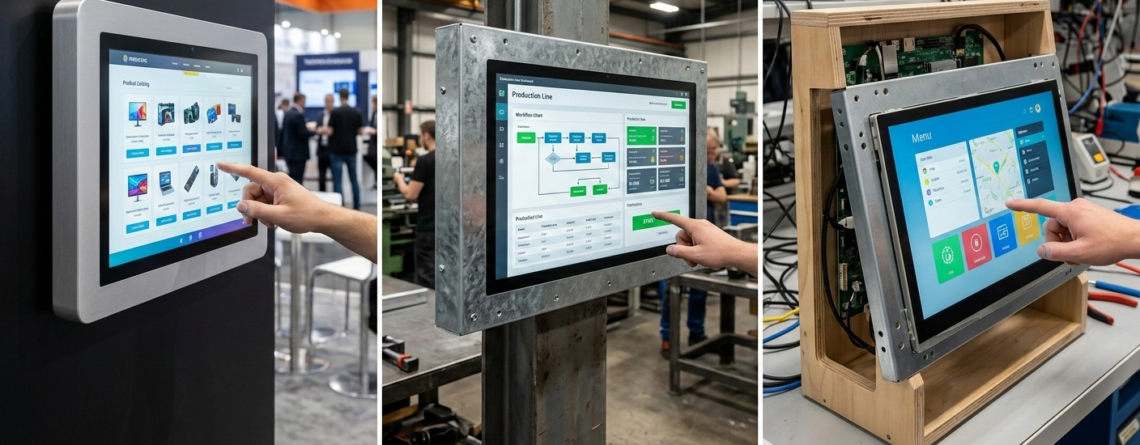
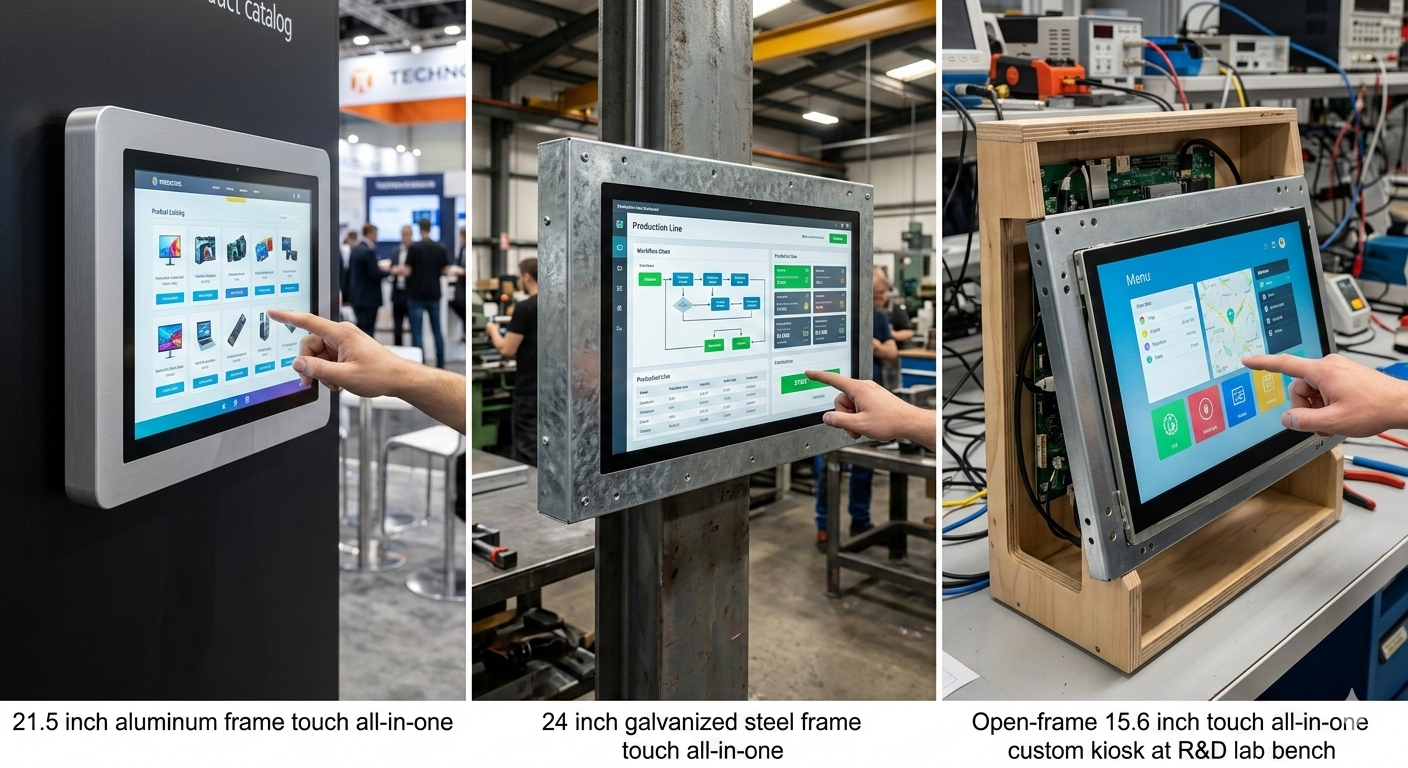
In the design blueprints of modern industrial automation and Human-Machine Interface (HMI) systems, the touch screen frame is often viewed by non-professionals as a mere border or decorative component. However, from the perspective of systems engineering and materials science, the frame is essentially the “external skeleton” and “environmental interface” of the display device. It carries multiple core functions, including physical protection, thermal management, electromagnetic compatibility (EMC), structural integration, and user interaction reliability. For Golden Margins, a company dedicated to high-performance display solutions, its aluminum alloy, galvanized steel, and Open Frame solutions reflect distinct physical properties and engineering logic. This paper explores the indispensability of frames in industrial applications and provides a detailed analysis of the advantages, characteristics, and life-cycle value of these three mainstream solutions.
1. System-Level Importance of Touch Screen Frames in Industrial Environments
The fundamental difference between industrial-grade touch screens and consumer tablets lies in the extreme and unpredictable nature of their operating environments. In factory floors, mines, medical operating rooms, or outdoor interactive terminals, the frame is not only the last line of defense for fragile internal electronic components but also the physical foundation for the entire system’s performance.
1.1 Structural Rigidity and Stress Distribution Mechanisms
Liquid Crystal Display (LCD) panels and Projected Capacitive (PCAP) sensors are extremely precise and fragile glass components. In industrial sites, these components often face high-frequency mechanical vibrations, gravitational pressure from operators, and accidental physical impacts. If a frame lacks sufficient rigidity, external stress can lead directly to micro-cracks in the glass substrate or sensor drift. Frame design must account for the material’s Young’s Modulus and ensure, through rational cross-sectional geometric design (Moment of Inertia), that deformation under pressure is controlled at the micron level, thereby protecting internal optical layers from damage.
1.2 Physical Carrier for Sealing Engineering and IP Protection Ratings
Environmental sealing is a prerequisite for the long-life operation of industrial displays. IP65, IP67, and even IP69K protection ratings require devices to resist dust penetration, high-pressure water jets, and even short-term immersion. As the primary carrier of the sealing gasket, the frame’s machining precision directly determines sealing reliability. Golden Margins utilizes precision-machined frames paired with industrial-grade silicone seals to create a permanent barrier at the metal-glass interface. This prevents dust and condensation from accumulating in the air gap, which is crucial for preventing internal short circuits and maintaining optical clarity.
1.3 Thermodynamic Management: The Frame as a Passive Heat Sink
In fanless industrial PCs or high-brightness displays, heat accumulation is the primary cause of electronic component failure. LED backlight modules dissipate significant heat when producing brightness above 1000 nits. Metal frames, with their high thermal conductivity, act as the system’s overall heat sink. By using Thermal Interface Materials (TIM), heat from internal chips is efficiently conducted to the frame surface and then dissipated into the air via convection and radiation. This “frame-as-heatsink” design not only eliminates noise and failure points associated with mechanical fans but also greatly extends the Mean Time Between Failures (MTBF) in high-temperature environments.
1.4 Electromagnetic Interference (EMI) Shielding and ESD Protection
Industrial sites are rife with complex electromagnetic interference, such as surges from large motors or radio frequency noise from wireless devices. A closed metal frame acts as a Faraday cage, effectively intercepting electromagnetic waves and preventing them from interfering with sensitive touch controller signals. Simultaneously, the frame provides a reliable grounding path. In the event of Electrostatic Discharge (ESD), it can quickly guide current to the ground wire, protecting internal ASIC chips from damage.
2. Technical Characteristics and Advantages of Golden Margins Aluminum Alloy Frames
Aluminum alloy has become the core material for Golden Margins’ high-end product series due to its excellent strength-to-weight ratio, superior thermal conductivity, and natural corrosion resistance.
2.1 Materials Science: Density Dividend and Strength-to-Weight Ratio
The density of aluminum is approximately 2.70 g/cm³, only about one-third of that of steel (Approximately equal 7.85 g/cm³). This lightweight advantage is particularly prominent in large-sized display devices of 21.5 inches and above. Lightweight frames significantly reduce the static load pressure on swing arms or wall-mount structures, lowering labor costs and structural failure risks during installation. For medical mobile carts or vehicle-mounted systems, aluminum alloy frames maximize portability and energy efficiency while maintaining sufficient rigidity.
2.2 Extreme Thermal Conductivity
The thermal conductivity k of aluminum alloy is typically between 200 and 235 W/m·K, more than four times that of galvanized steel (Approximately equal 45–60 W/m·K). In Golden Margins’ high-brightness industrial displays, aluminum alloy frames quickly diffuse heat from the LED driver board across the entire housing surface. This efficient heat diffusion mechanism avoids the generation of localized hot spots, ensuring that liquid crystal molecules work within their rated temperature range, thereby preventing color shift and life-span degradation.
2.3 Surface Engineering: Anodizing and Corrosion Resistance Mechanisms
Unlike steel, which requires additional coatings for protection, aluminum alloy spontaneously forms a dense alumina protective layer when exposed to air. Golden Margins further employs anodizing processes to increase the thickness and hardness of this oxide layer. This treatment not only gives the frame a modern, matte metallic texture (Sleek design) but also endows it with strong scratch resistance and chemical corrosion resistance. In medical environments frequently cleaned with disinfectants or ports with salt spray risks, aluminum alloy frames show high environmental adaptability and do not produce rust-peeling particles, meeting Class 100 cleanroom standards.
2.4 Electrical Advantages: High-Frequency Shielding and Low Impedance
With the proliferation of high-frequency wireless communications (e.g., 5G, WiFi 6), the high electrical conductivity of aluminum alloy frames makes them highly advantageous in shielding high-frequency EMI. Although the surface oxide layer is insulating, precision grounding contact designs can achieve extremely low overall impedance. This provides a “silent environment” for the touch screen, supporting Golden Margins devices in achieving high touch accuracy (± 0.5 mm) and ultra-short response latency ( ≤ 3 ms).
3. Technical Characteristics and Advantages of Golden Margins Galvanized Steel Frames
Galvanized steel frames are the most widely used structural solutions in the industrial field. Their design core lies in utilizing the high mechanical strength of steel and the sacrificial anode protection mechanism of the zinc layer to achieve high durability and economic balance.
3.1 Superior Mechanical Hardness and Anti-Deformation Capability
The Young’s Modulus of steel is approximately 207 GPa, while aluminum alloy is only 70 GPa. When facing strong impacts, high-pressure extrusion, or continuous low-frequency vibrations generated by heavy machinery, galvanized steel frames exhibit excellent yield resistance. Golden Margins’ galvanized steel frame series is designed for “hardcore” industrial use, such as mine consoles, steel mill monitors, or large automated machine tools. This material ensures that the screen maintains the flatness of the optical layer under extreme physical stress, preventing optical distortion or touch failure caused by frame twisting.
3.2 Magnetic Field Shielding and the Faraday Cage Effect
In addition to shielding electric fields, steel—due to its iron content—possesses high magnetic permeability. In environments with strong magnetic field interference, such as substations or welding workshops, galvanized steel frames can absorb and guide magnetic induction lines through magnetic circuit closure, preventing magnetic fields from interfering with the internal inductive components of touch controllers. This is a unique advantage that non-ferromagnetic materials like aluminum do not possess, crucial for ensuring the signal-to-noise ratio of industrial controllers in complex electromagnetic environments.
3.3 Corrosion Philosophy Under Sacrificial Anode Protection
The hot-dip galvanizing process is not just a physical wrap; it establishes an electrochemical protection system at the molecular level. The electrode potential of zinc is lower than that of iron. When the frame surface suffers severe mechanical damage and the internal steel is exposed, the zinc layer acts as an anode and is oxidized preferentially, thereby protecting the steel substrate (the cathode) from rusting. This self-healing protective mechanism gives galvanized steel frames an extremely long service life—often decades without maintenance—in applications prone to physical wear, such as ticket vending machines or public interactive terminals.
3.4 Cost Optimization and Economies of Scale
In large-scale infrastructure or retail chain projects, cost control is a core consideration. The raw material and stamping costs of galvanized steel are lower than the CNC milling costs of aluminum alloy. Golden Margins leverages the high cost-effectiveness of galvanized steel to provide large-volume, high-quality, and competitive display mounting solutions for ATMs and self-service kiosks.
4. Technical Philosophy and Integration Logic of Open Frame Architecture
Open Frame displays are more than just a product form; they represent a modular integration philosophy. It removes the outer decorative enclosure, retaining only the core display module, touch sensing layer, and structural brackets.
4.1 Extreme Integration Flexibility and Space Management
The most significant feature of Open Frame is its “borderless” design. OEM manufacturers and system integrators can embed it directly into customized metal enclosures, control panels, or mechanical housings without worrying about external frame compatibility. This structure not only reduces the external footprint of the machine but also eliminates gaps between traditional borders and the housing, allowing the front panel of the final product to achieve a “True Flat” design, greatly enhancing aesthetics and waterproof cleaning efficiency.
4.2 Modular Maintenance and Life-Cycle Cost Optimization
In traditional fully enclosed displays, damage to any component usually means disassembly or replacement of the entire unit, resulting in high maintenance costs. Golden Margins’ Open Frames adopt a modular connection architecture, where the internal LCD panel, driver boards, inverter, or touch controller are connected via standard interfaces and fixed to metal brackets. This design allows maintenance personnel to perform quick component-level replacements without altering the existing external structure, significantly shortening equipment downtime.
4.3 Optimized Thermal Convection and Customized Cooling Paths
By removing the sealed housing, Open Frame displays can more directly utilize the cooling systems of the integration environment (such as large cabinets or kiosk interiors). Designers can arrange air deflectors or additional auxiliary cooling facilities around the frame based on internal airflow. This “leveraged” cooling logic makes Open Frames excel in high-power embedded computing applications, avoiding performance degradation caused by heat accumulation within a display enclosure.
4.4 Deep Customization for Vertical Industries
Open Frame widely supports the seamless integration of various value-added technologies. For example, slots reserved at the frame edges facilitate the addition of privacy filters, Anti-Fingerprint (AF) coatings, or high-hardness tempered glass. For ATMs in financial security or medical diagnostic terminals, this high level of configurability allows Golden Margins to provide precise adaptation solutions based on different industry regulations and technical standards.
5. Quantitative Comparison of Physical Properties and Engineering Selection Advice
In actual engineering practice, the choice of frame material must be based on a comprehensive quantitative analysis of the operating environment, mechanical loads, and electrical requirements.
5.1 Risk Management of CTE Mismatch
During Optical Bonding, the difference in Coefficient of Thermal Expansion (CTE) between the display glass, touch screen glass, and the metal frame is a non-negligible technical challenge.
| Material | Linear Expansion Coefficient α (10−6/K) | Matching with Glass | Potential Risks |
| Soda-Lime Glass | ~8.5 – 9.0 | – | – |
| Aluminum Alloy | ~23.1 | Extremely Low | May cause delamination or glass cracking under extreme temperature differences |
| Carbon Steel (Galvanized) | ~11.5 – 12.0 | High | Superior structural stability, low thermal stress |
| Silicone Gasket | ~100+ | – | Used to absorb thermal deformation displacement |
According to the formula ∆L = α · L · ∆T, when the ambient temperature rises from -40 ℃ to 80 ℃, a 500 mm aluminum frame will produce a displacement of approximately 1.4 mm, while a steel frame produces only about 0.7mm. Therefore, for outdoor optically bonded displays, Golden Margins typically recommends galvanized steel frames or aluminum frames with added elastic sealing layers to compensate for this thermodynamic difference, ensuring long-term optical stability of the display system.
5.2 Trade-off Between Material and Wireless Signal Penetration Rate
With the application of IoT in factories, touch screens often need built-in Bluetooth, Zigbee, or WiFi modules for data transmission. However, all metal frames produce reflection and absorption effects (Faraday Cage Effect).
- Full Metal Body (Closed Aluminum or Steel Frame): Signal attenuation for 2.4 GHz and 5 GHz bands can be as high as 30 – 50 dB, basically rendering built-in antennas ineffective.
- Open Frame Solution: Allows antennas to be placed outside the metal frame during integration or transmitted through a non-metallic housing backplate. Golden Margins reserves non-metallic “RF windows” in some frame designs to balance structural strength with communication needs.
6. Precise Matching Decision Matrix for Industry Application Scenarios
Based on the physical characteristics and engineering practices mentioned above, Golden Margins has established a multi-dimensional decision matrix to guide customers in frame selection.
6.1 Medical and Clean Lab Environments
In medical scenarios pursuing sterility, ease of cleaning, and high aesthetics, aluminum alloy frames are the sole choice. Their natural oxidation resistance allows them to withstand strong corrosive disinfectants like hydrogen peroxide sprays, while lightweight characteristics reduce the load on operating room cantilever systems, enhancing the user experience for medical staff.
6.2 Industrial Automation and Heavy Machinery
In factory environments with metal dust, strong vibrations, and mechanical impacts, galvanized steel frames, with their extremely high structural hardness and Faraday cage effect, provide solid physical protection for PLCs (Programmable Logic Controllers) and HMIs. Simultaneously, their magnetic shielding properties protect touch screen signal integrity during frequent motor starts and stops.
6.3 Commercial Retail, Financial Terminals, and OEM Integration
For Kiosk terminals that need to be highly integrated into brand aesthetics or existing equipment, Open Frame displays provide the best ROI. Their modular design lowers long-term field service costs and supports system integrators in deep front-panel customization (e.g., integrating card readers, cameras, or printers).
7. Synergistic Effects of Frame Design and Frontier Technologies: Optical Bonding and AG Coatings
Golden Margins’ frame design does not exist in isolation; it is deeply coupled with core optical technologies.
7.1 Requirements of Optical Bonding (LOCA/OCR) for Frame Precision
The LOCA (Liquid Optical Clear Adhesive) bonding technology used by Golden Margins requires the frame to have extremely high coplanarity. If the frame warps slightly due to internal stress, the adhesive thickness will not distribute uniformly during the bonding process, leading to bubble generation or optical distortion after curing. High-precision CNC-machined aluminum alloy frames show unparalleled advantages in such high-precision assembly processes.
7.2 Anti-Glare (AG) Glass and Border Shadow Management
The height and slope design of the frame affect the visual performance at the screen edges. In outdoor high-brightness applications, if the frame edge is too high, it creates significant shadows and interferes with edge touch accuracy. Golden Margins’ narrow bezel design, paired with AG-coated glass, minimizes secondary reflections at the edges by optimizing the frame’s taper angle, ensuring information readability from all viewing angles.
8. Conclusion and Future Evolution Trends
As the physical boundary of industrial display systems, the touch screen frame carries multiple missions ranging from material mechanics to thermodynamics and electromagnetics. Aluminum alloy frames lead the high-end medical and commercial display markets with their lightness, efficient heat dissipation, and modern aesthetics; galvanized steel frames form the backbone of heavy industrial automation with their unyielding hardness, electromagnetic robustness, and economy; while Open Frames serve as the cornerstone for OEM innovation and life-cycle cost management through modularity and integration flexibility.
Looking ahead, as carbon fiber composites, high-strength engineering plastics, and flexible display technologies merge, frame design will move toward being lighter, stronger, and possessing “electrical transparency.” Golden Margins’ continuous investment in materials science ensures that its frame systems not only protect current display technologies but also provide the most solid physical carrier and environmental barrier for every HMI device amidst the waves of Industry 4.0 .
We hope you found these fundamentals on touchscreen or panel PCs informative. Goldenmargins offers a broad selection of Industrial Touchscreen Monitors and Touch Panel PCs in various sizes and configurations, including medical-grade, sunlight-readable, open-frame, and waterproof touchscreens, as well as other unique touchscreen or panel PC designs. You can learn more about our services here or by calling us at +86 755 23191996 or sales@goldenmargins.com.